Welcome & Closing - James Moore
MEETING OUR RESPONSIBILITIES: SUBSTANCE ABUSE AND LAW SCHOOLS
June 24, 2003
INTRODUCTION AND CLOSING REMARKS
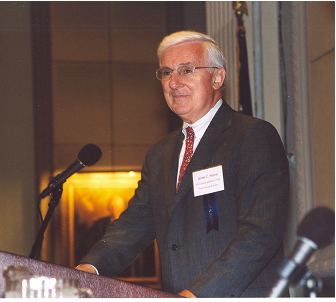 James
Moore: I would like to extend my personal appreciation,
and I'm sure your thanks, to the people who served as the organizing
committee for this conference. They are Bill Kane from New Jersey,
Ken Rosenblum from the Touro Law School, Eileen Travis, who runs
the LAP program here for the City Bar, Bonnie Waters who runs
the program for the State of Massachusetts Bar and, of course,
the incomparable, indefatigable Barbara Smith, who is the Executive
Director of the New York State Lawyer Assistance Trust. They
have all work tirelessly for the last six months to bring this
program to fruition. This is a program without a template, so
the work of the organizing committee was an unusually difficult
task.Â
James
Moore: I would like to extend my personal appreciation,
and I'm sure your thanks, to the people who served as the organizing
committee for this conference. They are Bill Kane from New Jersey,
Ken Rosenblum from the Touro Law School, Eileen Travis, who runs
the LAP program here for the City Bar, Bonnie Waters who runs
the program for the State of Massachusetts Bar and, of course,
the incomparable, indefatigable Barbara Smith, who is the Executive
Director of the New York State Lawyer Assistance Trust. They
have all work tirelessly for the last six months to bring this
program to fruition. This is a program without a template, so
the work of the organizing committee was an unusually difficult
task.Â
I also wanted to extend our appreciation to the leaders of the Association of the Bar in whose property we are now seated, for the help that they have given us to organize this conference, and for making this magnificent facility available for us to meet in. I want to thank Barbara Opotowsky who is the Executive Director for the City Bar for the help that she's given us.Â
In case you are wondering, we have in attendance representatives of 36 law schools, more than 140 people have registered to attend the conference, and we have people from as far away as Washington State with us. I also want to acknowledge the presence of John Clark. John is a lawyer from Texas, he is also the chair of the American Bar Association’s Commission on Lawyer Assistance Programs, and he's been good enough to take the time to come and join us; he will say a word or two during a lunch break. Donna Spilis, who is the Staff Director of the American Bar Association's Committee on Lawyer Assistance Programs, is with us, and Donna has played a significant role in organizing this conference.Â
Finally, although every one of our speakers is a distinguished person in his or her own right and knows this subject better than almost everybody in the room, I want to give special thanks and I can't let this moment go by without thanking Bob Stein, who is the Executive Director of the American Bar Association, for being with us this morning. Bob and I first met about 40 years ago when he was a first year associate and I was a summer law clerk at a firm in Milwaukee, which is now known as Foley & Lardner. Bob went on to greater fame and fortune, first becoming a partner in that firm, a firm that's now I think more than 1,000 lawyers, and then became a Professor of Law, a Dean of the University of Minnesota Law School and ultimately became the Executive Director of the American Bar Association, which is the world's largest voluntary association of professionals.Â
I need not say to anybody in this group anything more about the scourge which substance abuse, whether it is in the form of drugs or alcohol, is upon our society. Even a cursory look at some of the statistics is arresting. One in every thirteen adults in the United States is either believed to abuse alcohol or is a confirmed alcoholic. There are thought to be three million teenagers between the ages of 14 and 17 -- just in that small bracket -- three million teenagers who are problem drinkers. Alcohol is known to contribute in more than a significant way to more than 100,000 deaths in this country every year.  The cost of alcohol or drug abuse to our society measured in lost production and medical expenses can be measured not in millions of dollars but in tens of billions of dollars.Â
In our profession the statistics are equally bleak. Seven years ago a report appeared in the Journal of Law and Health, which noted a study that showed that between 15 and 18 percent of the lawyers in the survey area were problem drinkers or were confirmed alcoholics. New York's disciplinary committees have reported that as many as 65 percent of the complaints against lawyers have a connection with substance abuse. And, of course, the toll caused by alcohol and drug abuse on professional practices, the lives and businesses of our clients and our families is incalculable.Â
Just this week, the New Yorker has an article, which I am going to read just a very brief portion of to you, about the issue of substance abuse in the profession. This article is just a little crude, I apologize for reading some of the crude parts of it, but here is what it says; they are quoting an e-mail that was sent by a summer law clerk to his colleagues at one of the big firms here in New York City as he concluded his summer stay. The author apparently was not a fan of summer camp for lawyers and then it quotes him, "I did not get shit-faced drunk like the rest of you every day." But he had more specific complaints about the firm's bigotry, then a quote about its bigotry, and then he concludes, "In its leisure pursuits, I will also not speak of the blatant use of cocaine in people's offices."Â
For many years a connection between substance abuse and the years spent in law school has been the subject of considerable concern and study. It is believed, for example, that law students who may be predisposed toward some form of substance abuse will find abundant opportunities for that predisposition to flower during the years in law school. More than ten years ago, the Association of American Law Schools under the leadership of then Dean Robert Stein, prepared an exhaustive and seminal study on the issue of substance abuse in law schools. It is therefore to that subject that we will turn our attention during the next 6 hours.Â
[PLEASE SEE OTHER HEADINGS FOR OTHER SPEAKERS’ REMARKS]
CLOSING REMARKS
James Moore:            Thanks to all of our panelists. Let me see if in closing in two minutes I could summarize some of the main themes that we have talked about today.Â
ü Substance abuse in the profession remains a problem.
ü Substance abuse in law schools is a problem, for both students and faculty.Â
ü It is difficult to address the problem in law schools because of denial, because it's easier to ignore it, because students and faculty are adept at hiding the problem, because there is fear of the impact of admitting the problem on admissions, and because of lack of time.Â
ü There is some thought that while the problem may be better or less acute than it was 10 years ago, there is also some thought that it may get worse in the next few years.
ü There is an absolute certainty that people who have problems with alcohol and do not treat it will continue on into the profession and cause havoc with that problem in the profession.Â
It's important to keep this problem in perspective, on the one hand if you were told as a Dean of Students that 15 percent of the students in your school had SARS, or AIDS, or a form of cancer,
there would be hell to pay. Something would be done right away. People would be wearing masks; there would be epidemiologists at the school; there would be physicians.Â
Why isn't that kind of attention being paid to the fact that we know that 10, 15, 18 percent of the students have some problems with alcohol or substance abuse?Â
On the other hand, and the perspective area as Judge Bellacosa said, we have to realize that there are no macro solutions to this problem, it is an ongoing, unending problem, and we really have to address it one student, one faculty member, one day at a time.Â
It is important that the public know that as a profession we are trying to do something about this.Â
Some of the specific steps that you have suggested during the course of the day are:
Ã~ 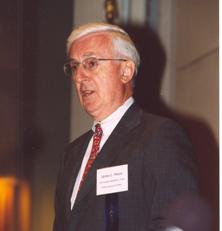 To have somebody charged with the responsibility
for the substance abuse issue on the administration of the faculty
at every law school;
To have somebody charged with the responsibility
for the substance abuse issue on the administration of the faculty
at every law school;
Ã~ That there be a written policy about how substance abuse once determined to exist will be addressed at your law school;
Ã~ That you consider using less alcoholic beverages at school functions;Â
Ã~ That students be spoken with openly and candidly about the problem as soon as possible;
Ã~ There seems to be a strong sense that voluntary programs about this issue will not get very far, it seems to be that a mandatory program is essential early on, and that the program should address the issues of confidentiality;Â
Ã~ The notion that if you talk to somebody about this, your disclosures are confidential;
Ã~ That if you don't address the problem as a student on a personal level that it may affect your ability to be admitted to the Bar;Â
Ã~ That help is available. This is essential in talking to people that there are agencies, there are people, there are services out there who can help you to work with the problem and as somebody said during the course of the day, students, law students need to be told it's time to grow up and put some of the ways of your youth behind you;
Ã~ Another suggestion is to establish a relationship with your local LAP and try to tap into the skills that those people have available;Â
Ã~ Still another was to work with law examiners to discuss the impact of substance abuse on the admissions process, and be certain that you have a clear understanding of how an admission by a student is going to impact their right to seek admission to the Bar;Â
Ã~ And still others and a very unique suggestion was the one that Mark made in the last few moments, and that is to try to address this as a health related issue and seek to find ways that you can divert people's attention from relief through substances and offer them other alternatives.
Bottom line on all of this is that there is a problem and that every one of us can do something about it. On behalf of the organizing committee, I wish they could all stand up here and take a bow. I would like to thank you for the time that you have taken to come. Just a great group, it was a seamless program, I have learned so much today, I hope you share my enthusiasm for it, and I hope you go back to your places of employment and jump onto this problem. Thank you very much.
*************
Biographical Information
James C. Moore
Harter, Secrest & Emery LLP
B.S., Cornell University; L.L.B., Cornell Law School
James C. Moore is a partner in the firm of Harter, Secrest & Emery LLP, Rochester, New York. He served as President of the New York State Bar Association 1998-1999; National Conference of Bar Presidents, Executive Council, 1999- ; Fellow, American Bar Foundation and New York Bar Foundation; Member, ABA House of Delegates, 1998 - ; Elected member, American Law Institute. Moore is a frequent author, contributing numerous articles on such varied topics as product liability law, third party litigation, construction litigation, and multidisciplinary practice for publication by West Publishing, the New York State Bar Association, and book reviews for the New York Law Journal.