Panel: Law Schools & Substance Abuse
MEETING OUR RESPONSIBILITIES: SUBSTANCE ABUSE AND LAW SCHOOLS
June 24, 2003
PANEL: LAW SCHOOLS AND SUBSTANCE ABUSE
James Moore, Moderator: I would now like to introduce to you Judge Robert Childers, who is going to speak and moderate our first panel: Law Schools and Substance Abuse.
Judge Childers is serving his third term as a trial Judge on the Tennessee Circuit Court. Prior to being elected to the Tennessee Circuit Court, the Judge graduated from the University of Memphis as an undergraduate, and from its law school, he then practiced law in a general practice firm for several years and ultimately became a Judge. The Judge is a founding member of the Lawyers Helping Lawyers program in Memphis. He is a member of the Tennessee Lawyer Assistance Program and for several years Judge Childers has served on the American Bar Association's Committee on Lawyer Assistance Programs where, I believe, he chairs that committee's group on law school outreach programs. It's my great privilege to introduce to you Judge Butch Childers from the Tennessee Circuit Court who will, in turn, introduce the next group of panelists.
Robert Childers: Thank you very much, Jim. While the other panelists are joining us on the podium, I want to add my thanks to what the Chief Judge has already said; I want to thank Jim Moore and Barbara Smith.
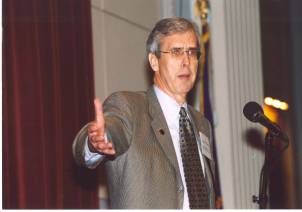
I am amazed and pleased and gratified to see such a wonderful turnout, and I again want to thank you for your interest and your participation and your hard work. As I have told the members of the law school outreach subcommittee of the Commission on Lawyer Assistance Programs (CoLAP), this is not a sprint: this is a marathon. I want to again thank you for all of your hard work and your interest in this very important area.
I want to introduce the other two members of our panel this morning.
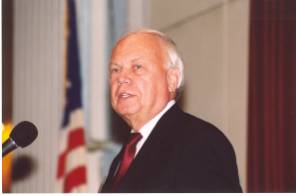
Robert A. Stein is the Executive Director for the American Bar Association and has been since 1994; he's the Chief Operating Officer of the ABA. As Executive Director of the ABA, he oversees the staff of more than 900 persons and a budget of more than $180 million. Dean Stein has served as the ABA chair of legal education and admissions to the Bar; he also served as a member of the American Bar Foundation Board of Directors and the Minnesota State Bar Association Board of Governors until his selection as Executive Director of the ABA in 1994. He is a member of the counsel of the American Law institute and a member of the Executive Committee of the national conference of commissioners on uniform state laws. He is also a fellow in both the American College of Trusts and Estates Counsel and the American College of Tax Counsel. He is the former Dean of the University of Minnesota Law School in Minneapolis.
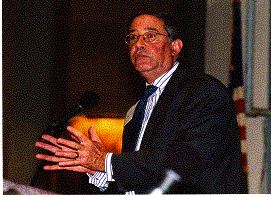
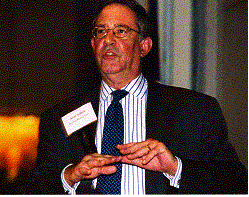
The other panelist that we have the good fortune to have on the program this morning is Dean John A. Sebert. John was named the consultant on the Legal Education Committee of the American Bar Association in March of 2000. In that role he oversees the national law school accreditation process for the Council of the ABA on legal education and admissions to the Bar, which is the nationally recognized accrediting agency for law schools. He served as Dean and Professor of Law at the University of Baltimore School of Law. During his time at Baltimore he served in many capacities as a volunteer for the ABA. He chaired at least one site evaluation team a year from 1993 to 99, and he was a member of the ABA accreditation committee from 1999 until his selection in 2000 as consultant designate. From 1974 until 1993 Dean Sebert served on the faculty of my home state university law school, the University of Tennessee College of Law in Knoxville. He's authored numerous articles on remedies in contract and commercial law and on consumer protection that appeared in numerous law review publications. Dean Sebert has also co-authored a course book Remedies, Damages, Equity and Restitution, the third edition of which was published in 2002. So Dean Sebert has been very, very busy in his scholarly activities while serving the ABA Legal Education Committee. He's also a legal Fellow of the American Bar Foundation and the Maryland Bar Foundation, and he is an elected member of the American Law institute.
Dean Stein and Dean Sebert actually literally wrote the book on this subject. In the early 1990s the Association of American Law Schools decided to approach this area of substance abuse, the problem of substance abuse in American law schools. Dean Stein was asked to chair that special committee and Dean Sebert was also a member of that committee. In 1993 the special committee published a report and both Dean Stein and Dean Sebert will tell you much more about the details in just a moment of that report. But they literally wrote the book on the problems that are ongoing of substance abuse in law schools. So without further introduction, I am going to turn it over to Dean Stein; Bob.
Robert Stein: Thank you very much, Judge Childers, and good morning to all of you. It's a pleasure to be part of this important program. As Judge Kaye told us, this is the first one in the galaxy, so it's an honor for each of us to be here, and also participate with the distinguished panel. Judge Kaye is one of the giants of our profession, and those of you practicing in New York are very fortunate to have her as your Chief Judge because Judge Kaye is usually at the forefront of almost every issue affecting the administration of justice in this country.
As you have heard Jim Moore say, we go back some 40 years, if it's possible to believe that, Jim, and to be back on a program with you again after so much time is a great personal pleasure.
The subject is the role of law schools in this very serious issue of substance abuse, and particularly substance abuse by members of our profession. Both Jim Moore and Judge Kaye gave you some of the statistics, and you can go on and on giving examples of this. The estimate is more than 10 million of our citizens suffer from alcoholism, or some form of alcohol dependency and many million more have other substance addictions that will impair their health or their functioning, professional or social functioning.
 Unfortunately, attorneys are not exempt from this problem;
indeed some studies have reported that members of our profession have even
a higher rate of substance abuse than that experienced by the general population,
and again, to state that statistic that was mentioned earlier this morning,
estimates are that 50 to 75 percent of the discipline cases involve some
form of substance abuse.
Unfortunately, attorneys are not exempt from this problem;
indeed some studies have reported that members of our profession have even
a higher rate of substance abuse than that experienced by the general population,
and again, to state that statistic that was mentioned earlier this morning,
estimates are that 50 to 75 percent of the discipline cases involve some
form of substance abuse.
So this is a serious, serious problem that should engage the attention of every member of our profession, and we are asking ourselves in this first panel this morning what is the role of law schools in connection with this issue. Are law schools doing all they can to prevent the problem of substance abuse? Are law schools educating future lawyers about the issue and equipping them with the knowledge that they can use to ensure that they can avoid this problem in their own lives and in the lives of colleagues? Or, in fact, are law schools in some way encouraging the use and abuse of alcohol and other drugs.
We all know from our law school experience that one thing law schools do is give receptions. There is a reception for almost everything and at most of these receptions alcohol is served. In fact, at one time there weren't any other alternatives but alcohol, beer and wine at these kinds of programs. So there is a subtle encouragement there that this is a very appropriate way to engage in professional interaction within our profession. Are law schools equipping students to develop behavior patterns that could help them resist substance abuse, or, indeed, are the stresses of law school creating the kind of behavior patterns that later lead to addiction and other dependencies? Are students, in fact, learning one of the ways to cope with the pressures of law school is to go out and have some drinks at the end of the evening, or the end of the week in order to get by? These were the kinds of questions that we addressed some many years ago in the study that was undertaken by the Association of American Law Schools.
As you have heard, I was privileged to chair that commission and John, Dean John Sebert was then deputy Executive Director of the Association of American Law Schools and was the principal person involved with us in drafting the report. It was a major study. The decision was made at the outset to engage in a very sophisticated form of social science empirical testing to develop a fact pattern that would say exactly what the situation was. So we did have the participation of almost 70 percent, 121 law schools throughout the United States. It was a very high rate of percentage participation. Then we picked law schools to go out and get questionnaires from students. A lot of time was spent, I remember many meetings identifying law schools that were representative of all law schools in United States, we looked at public versus private, religious versus secular, urban versus rural, geographic distribution, all of the characteristics that describe law schools.
From those law schools we sent out questionnaires and have responses from 3,400 law students. So this 3,400 law students described in great detail their own personal experience with regard to substance use and abuse. Some were first year students, some were second year students, some were third year students, and we were able to discern trends that might happen in law school, was substance use increasing during this period of time, were there differences between men and women, were there differences between younger students and older students? A great deal of detail about patterns within law schools. It was interesting.
We experienced a lot of denial by Deans of the law schools during these periods of time when we asked them to participate in the study, the deans said well, there may be a problem somewhere, but not in my law school, I can assure you of that. Also the feeling that why do we want to get involved in this? This is really not an academic subject, is this really central to the mission of law schools? Those were the kinds of issues that obtained at that time. The study is now 10 years old, regrettably it hasn't been replicated since that time.
Anecdotally, and we will get into that a little bit today, we believe in some respects the situation is better now than it was in the mid '90s, but in many respects the conditions still obtain, and it's not the sort of thing that you do once and then it's done and move on, it's an issue that must be continually addressed. At the time the study was completed some major conferences were held by the Association of American Law Schools, in which most of the deans of the nation's law schools were present. There was, I think, a great broadening of the understanding and experience of the issues. But one of the consequences of American legal education is there is a rapid turnover in Deans, and most of those Deans have now moved on to everything else and we have a whole new generation that are there, and to some extent the same denial and the same lack of concern exists today. So what we would like to do is take you through the study, some of the things that it found, and extrapolate that to what we believe the situation is today. So I would like to turn it over now to Dean Sebert who will talk a little bit more about the methodology of the study and then the specific findings with regard to law students and recommendations with regard to law students, then I would like to come back and talk a little bit about the recommendations with regard to faculty of the law school; John.
John Sebert: Thank you. I am very happy to be here and pleased to talk with you about the study, about our findings and about the recommendations concerning particularly law school policies that were contained in the report.
My work with this special committee was the most satisfying single project that I undertook during my two years as deputy director of the AALS. You spend a lot of time pushing paper in some of those jobs, as does my deputy, and I think the report is quite clearly one of the most important reports that the Association of American Law Schools has ever produced. It addressed a serious problem; it provided real data, hard information and thoughtful recommendations for the law schools and the community. I talked yesterday with Carl Monk, the Executive Director of the AALS, and suggested to him the utility of their reissuing just this report sometime early this fall to law school Deans to call to their attention again both the data that's in it, the problem that exists and the recommendations. Carl said that he would look at that very seriously and take that to his Executive Committee with the prospect of recirculating the initial report to Deans early in the fall.
Bob, I think, did a very good job of describing the methodology for the student survey. All I will say about the methodology and the survey, other than to talk about some of the results, is it's the first time the AALS ever tried to do an empirically valid survey that represented, I think actually produced a sample that was reasonably well representative of the 128,000 law students at ABA approved schools in 1991. It's also to my knowledge the last time they have done it. It was a huge effort. Rick White, our data specialist, probably spent close to half his time over a two-year period on this project. Not many of us have the staff that allows us to do that. I am very glad we did this one.
Some of the information that came out of the report, the responses from these close to 3,400 students, those who study substance abuse told us then that the most reliable indicator of regular use of a substance is the respondent's answer to the question have you used this substance within the last 30 days, so that was a key question in the survey. The responses were not surprising:
- 82 percent of the respondents said that they had used alcohol in the last 30 days,
- 8 percent said that they had used marijuana,
- 9 percent said that they had used some sort of illicit drug.
We were buoyed our confidence in the validity of these results in the fact they were very similar to the results of a survey undertaken of medical students in the late '80s. Medical students and law students aren't all that different, except some of them deal with blood more easily. We also asked in the survey for some self-reporting information with respect to abuse of substances. We defined it carefully as abuse using a substance in a manner that does physical, psychological or emotional harm to yourself or others.
- 31 percent of the respondents said that they had abused alcohol sometime in their life; not a surprise.
- 12 percent said they had done so since they enrolled in law school, and this was first year, second year and third year students, relatively evenly spread among those three divisions.
We also asked about impairment, and again, we defined it pretty carefully in the survey. Impairment, having the use of a substance seriously diminish personal well being, ability to interact socially and/or academic, occupational aptitude.
o 13 percent reported substance abuse had affected class attendance.
o 7 percent reported it had affected class participation, probably not surprisingly,
o only 3 percent said they thought themselves they had a problem with substance abuse, but that's 3 percent. Even that's 3 percent of 128,000; you can do the math.
o But 37 percent said they thought that one or more of their student colleagues in the law school were impaired by substance abuse; that probably doesn't surprise you either.
o 21 percent said that they perceived that one or more members of their faculty was impaired by substance abuse.
o And that was enforced by the study of law school administrators where 26 percent of the respondents at law schools, and remember, this was two-thirds of the ABA approved schools filled out the law school survey, 26 percent of the administrators said that they thought that over the past five years at least one member of their faculty had his or her performance as a professional impaired by substance abuse.
So the message of the committee to the law school role then was multifaceted; hey, folks, the problem is serious and pervasive, it's not just those other folks that have the problem, the problem extends into the profession, and as we all know, substance abuse is a progressive disease. If you have a law student who's having problems when he or she is in law school, those problems are likely to get a lot worse when they are under pressure in their first years in practice; et cetera.
So, with that overview of the survey results, let me then talk to you about some of the committee's recommendations to the schools concerning policies and practices generally, and particularly with respect to students. Paraphrasing Judge Kaye, the gravamen is education, counseling and early intervention. And those were the basic foci of most of the recommendations. We recommended that law schools develop their own independent or supplementary policies concerning substance abuse. Most universities have them, but those policies, university policies did not in our judgment adequately focus on the particular problem of substance abuse in the legal profession, and the particular relationship of the risk of substance abuse to the ability to obtain or retain licensure.
When we wrote this report in 1991 or when we did the survey, only about 25 of the 176 ABA approved schools actually had independent law school substance abuse policies. My sense, it is anecdotal, is that since then a substantial number of additional schools have developed those policies. We recommended that the law schools should designate at least one individual within the law school as a substance abuse coordinator, both for the purpose of counseling and for the purpose of overall administering and ensuring compliance with your policies and systems. We actually suggested that it may be you want two, because it may be that the coordinator who is within the administration is so closely tied to the administration that some students or faculty might be unwilling to come to that individual for counseling purposes, and also you may not want your primary counselor to be -- also we will talk about this later -- the person who fills out the certification for Bar application because of some desire to have as much confidentiality as possibility, at least in the early counseling areas. Third, we recommended that while schools implement a substantial educational program, that particularly some substantial attention to substance abuse be paid, either in orientation or early in the first year, that you integrate discussion of these topics into some of your courses, particularly your professional responsibility course, and that you work closely with your local CoLAP programs or other Bar assistance programs in developing these programs.
Actually when I was Dean at Baltimore I hired a very good Associate Dean for student affairs, Tony Duran and Tony has worked very closely with Richard Vincent and the people in the Maryland State Bar Association's programs. We bring Richard and his people into the law schools, and there is a close relationship with respect to counseling and referring. It's working very well, I'm sure it's happened in a lot of your other schools, the point is it can work and if people want to talk to people who know about it, talk to Tony Duran, the Associate Dean for student affairs at Baltimore and to Richard Vincent over there, it's a good working relationship. We also said law schools should be prepared to intervene early. We didn't suggest how you do that, that's to the professionals, but we did suggest that schools should develop protocol as to how they will do this. Now, I am not sure that many schools have developed a formal protocol as to how they would deal with a situation when they thought they needed to intervene, my guess is a lot of it is more ad hoc, we are going to figure out how to do it when we see what the problem is. But I think at least it's fair to say that schools are paying much more attention to that and to the recognition that they do have problems among their students that need to be addressed as a matter of professional responsibility. And also suggested is that after all, once you intervene, you at least need to be in a position where you can inform the individual about the treatment options, and the system probably ought to at least provide opportunities for counseling. You are not going to be able to provide the treatment within the law school or the university, but counseling about it ought to be available.
We recommended strongly, building on one of the things that Bob said, alcohol has been, probably still is pervasive in law schools, but law schools ought to at least develop an alcohol policy. A policy that -- we didn't tell them again what their particular policy ought to be, that will depend on the individual law school, the individual university and its history and policies. But it ought to cover topics like what types of events should you serve alcohol at? Are there times where you shouldn't? Should you always have an alcohol alternative? How are you going to train the people who are serving the alcohol with respect to cutting off the bar at appropriate times for people; those things. We developed one of those at Baltimore, I'm sure, again, many of you also have -- I think not many schools had those types of specific policies before this report was issued.
With respect to disciplinary sanctions when someone, a student clearly does have an alcohol abuse or substance abuse problem, we really recommended that to the extent possible that the law schools use their disciplinary systems only as a basis of reinforcing or being consistent with a disease and treatment model. So you use it to reinforce treatment, to require, for example, counseling as a condition of continuing enrollment when the person clearly has a problem, to impose suspension pending necessary treatment, if necessary. But not to completely close the door. And we found it working pretty well at a number of schools.
Finally, one of the special committee's most important series of recommendations dealt with the problem of confidentiality and Bar admissions. Look, Bar admissions authorities have a legitimate interest in information and knowing when an applicant has a problem that has a substantial risk of impairing his or her ability to perform in a competent way in the profession. On the other hand, we also know that one of the first questions a student is likely to ask somebody at the law school when he or she comes in saying oh, by the way, I've got a friend who's got a problem, right, is hey, look, what's going to be the situation with respect to Bar admission? And the risk of disclosure or more likely the risk and uncertainty as to how Bar admission authorities will deal with the situation when an individual does disclose that they have a problem and are beginning treatment, are under treatment, et cetera.
It's a real problem. If the individual has reason to believe that the Bar admissions authorities understanding that they have this problem is going to automatically mean delay or denial of admission, you've got a huge disincentive to seeking counseling and treatment. So that's the dilemma that we all know about and we all deal with, or try to. We were informed by the protocol that the medical schools had developed, because they work closely with their state licensure agencies, and we had a medical school faculty member from the University of Memphis on the committee, they work closely with the medical school licensers to ensure the licensure agency maintain the confidentiality of the information that they got, and that they would relatively guarantee that an otherwise qualified individual who was recovering and in treatment, would not be denied license or substantially delayed in the licensure process. So that was the basis of our recommendations.
One of the most important, I think, group of recommendations, that law schools should try to work with their relevant Bar admission authorities to try to ensure that authorities will maintain the confidentiality of the information, that inquiries concerning past substance abuse be limited to relatively recent past on your Bar applications, and that otherwise qualified applicants who are recovering from substance abuse will not be denied or substantially delayed admission to practice. I think there has been some movement there, but I think this is an area where there is still a huge challenge, and I think Judge Childers will want to talk a little bit more about it. I would say again, my friends in Maryland have developed a pretty good process that you might want to talk to Richard about.
Finally let me close with a story -- a story about some of my personal experiences as a Dean in dealing with the problem of substance abuse by a member of the faculty. When I was Associate Dean and Acting Dean at Tennessee I find this problem by a faculty member who is probably pretty clearly abusing, didn't look like it was interfering directly with his teaching, so I ignored it, as many of us could. In 1992 a guy by the name of Tom Reid, then Dean at Hastings, made a very strong presentation at an AALS annual meeting. He said when he started in his first Deanship he was among that group, too, find some concern about faculty substance abuse, “let's just ignore it, it will go away, it will resolve itself”, right. He said he changed his mind about that after a few years, and told some stories, he was lucky, he had been Dean at four schools, and so it was not easy to identify his colleagues. Over those four Deanships he worked with faculty at each of those four schools to help them, sometimes successfully, deal with their problems of substance abuse. So I get to Baltimore as Dean in the summer of 1993 and in October a colleague comes to me expressing concern about one of her faculty colleagues about alcohol, overuse of alcohol impairing the individual's teaching. I decided that I wasn't going to ignore it, I worked, myself with human resources, and with a couple of faculty colleagues who were good friends of the individual, we were able early on to convince the individual to go into treatment. Actually worked for a couple of years. Got better, eventually slid back. The person eventually was no longer able to teach, had to retire, but for a couple of years it did work. It's actually one of the hardest things I did as a Dean, I felt for the faculty member, but I also realized that I had a responsibility to my students to ensure that they were getting competent instruction, and that if I saw a serious problem, I didn't have any choice but to work on it. If it hadn't been for my work with the special committee, I might have been one of those many of us who chose the easy path of not to act and so I am glad I did it. Thanks.
Robert Stein: Let me pick up on that theme of impairment of faculty members. You recall in the 19 schools that were selected for the additional review by questionnaires by students, were representative of all of the law schools in the United States and students at nearly every one of those schools reported that there was at least one faculty member that they believed was impaired by the use of alcohol or other drugs. So this is an issue that law schools should not ignore or avoid, and though there are a number of representatives of law schools here, so this is a very pertinent and immediate question for each of you.
Impairment of a faculty member at a law school has a number of negative consequences that go beyond the tragedy of that individual's life. First of all, there is a quality of education that is delivered to the students at the school, and for the school itself, oftentimes there is a diminishment of participation by that faculty member in productive scholarship or other activities in the community life of the school: diminishment in public service participation that should be the normal role of any member of a faculty. But beyond that, ignoring an obvious situation of substance abuse or impairment sends exactly the wrong message to all of the students that we are educating about how to deal with a problem such as this. Just look the other way and not help our colleagues come to grips with problems that are affecting them. So, our committee felt that there was a very special responsibility for law schools to act in this situation, and those recommendations are also set forth in the report which you have an executive summary.
First of all, each law school should have a written policy regarding faculty substance abuse. A written policy, not just a discussion, an understanding view of what we do if something like this comes up, but a written policy, emphasizing education, counseling, treatment and rehabilitation. In other words, the education and treatment model that we have been talking about all morning. Next, the written policy should be communicated on a regular basis to faculty members. It shouldn't be just in that sheaf of documents you get when you join, you sign up for your pension plan and withholding and all of these things and get that the papers go into a file somewhere. But this policy should be distributed on a regular basis, perhaps annually in some form as a part of material that comes out from the administration of the school.
Next, each law school should have a plan for dealing with an impaired faculty member, and the committee felt that this should be the product of a discussion between the Dean and the faculty. There ought to be time set aside at a faculty meeting in a general sense when we are not talking about any particular individual, but what should be our plan for dealing with this kind of a situation. My own experience is a little bit like what Dean Sebert indicated, although I was Dean at one law school for a very long time, I served for 15 years as Dean, and for many years there was a faculty member at that school, it was pretty obvious to the rest of us that he was just getting by, he could meet his classes, but not much more, and I am not proud of the fact that I was part of the group that just tolerated this, that had been done under the Dean before me and I continued that.
But after getting some insight into this situation, we did have an intervention that dealt with the situation, eventually he had to leave teaching because he couldn't quite cope with that problem, but it was something that needed to be done and it communicated an important message to the entire law school community, faculty and students.
Another recommendation, a person should be identified within the law school community for implementing the faculty substance abuse policy. Again, the suggestion was that this should be the product of the discussion the Dean has with the faculty about this. The thought was preferably it should be another faculty member and not a member of the administration, not an Associate Dean or the Dean herself or himself, but that a colleague that would be respected by all the members of the faculty should undertake that role.
Next, the law school's plan should provide for early informal intervention, and that intervention should involve a communication of the treatment options that are available and the sources of assistance that would be available to that faculty member.
Next, law schools should ensure that the health insurance program for faculty include coverage for treatment of substance abuse problems, particularly in extended situations. In many situations it's a financial issue to be able to afford the treatment that is necessary.
Next, the disciplinary action should be the last resort after counseling and education, treatment and employed to ensure that the faculty member participates in the treatment program that has been prescribed.
The final recommendation of the report, and I think is stronger today than it was when the report was written, and that is the law school should develop a very close relationship with the lawyer assistance programs available in that city or state, and there has been such wonderful and strong development of LAPs over the past several years, that this is a much stronger resource than was ever possible at an earlier time.
Where are we today? In some respects it's been kind of a deja vu experience to come back to this study after leaving it so many years ago. As I indicated earlier, when the report came out, we had many national conferences, there was a subject at a Dean's workshop and there was a great awareness of it in the law schools in the country. I think there has been some improvement. This is more anecdotal than anything else, but I believe now law schools make a greater effort to provide nonalcoholic alternatives at receptions, I think that there oftentimes is a discussion of this subject at the orientation program of the law schools. I think particularly at Dean of Students areas there is a greater understanding; there is a discussion in their own professional subgroups about it. But at the same time, it's clear the problem persists and we need to continue to address it. I do think, as I said, there are more resources available today and one particular resource is the Lawyers Assistance Program which is the subject of the American Bar Association's Commission on Lawyer Assistance Programs and Judge Childers, who is the chair of the law school outreach committee of that program will now talk about ways in which your Lawyer Assistance Program can assist law schools in coping with this problem. Thank you very much.
Robert Childers: Thank you very much, Bob. I want to make a comment about John Sebert's remark about the difficulty of this work. As Jim Moore said in his introduction of me this morning, I was a founding member of the Memphis Lawyers Helping Lawyers program in 1987. That program came about as a result of a suicide of a very well respected lawyer in Memphis, relatively young lawyer, brilliant mind, he had worked as a public defender as well as in private practice, just a very creative mind. One day we woke up and he had committed suicide. And nobody really knew what was going on with him, nobody really knew that there was a problem that was of such significance to him as to cause him to take that drastic action.
You know, my job as a judge is extremely difficult. My job as a lawyer was very difficult. Your jobs as Deans, Associate Deans, Lawyers Assistance Program personnel and staff, are all very difficult. But the hardest work I have ever done has been involved with the work of addressing these issues of our colleagues and friends and people we care about, people who are suffering from these issues. I decided at the time a group of us literally were sitting around at the wake of this lawyer and lamenting the fact that nobody really knew what was going on, or understood, and there ought to be some way for us to try to help our friends and colleagues and people we care about who are suffering from these issues. So the alternative to doing this hard, sometimes gut-wrenching work is to not do anything. I personally got tired watching people I care about, people that I loved and colleagues that I worked with killing themselves.
Some folks are afraid to lose friends. I may lose a friend if I point out to a person that they are having an obvious problem that's impairing their practice. The alternative to that is losing a friend forever. Because that's typically what happens, particularly with the drug and alcohol related issues.
Now, the other issue that's the biggest issue the health professionals tell us today in the legal profession, and that's depression. We in the law have probably the most stressful profession there is. So the alternative to reaching out and helping our colleagues, including law students, is doing nothing and watching people around us die. So I didn't really have an alternative, and I hope you feel the same way, and I'm sure given your interest and your attendance today that you do feel the same way.
I want to talk about the work of the law school outreach subcommittee. The AALS report came to the attention of the commission last year and in August at our annual meeting in Washington, D.C. last August, we decided to create a law school outreach subcommittee of the CoLAP commission. We have assembled what I consider to be a blue ribbon panel of commission members who are LAP directors and LAP personnel, Deans of law schools, Associate Deans of law schools, and with all due deference to the Deans, I understand that it's the Associate Deans who actually get things done in this particular area. So I want to talk to the Deans, but I also want to talk to the Associate Deans, because you folks are the ones who really have to deal with the problems on a daily basis, and again, I thank you for being here.
At the first meeting that the subcommittee had in San Diego in February of this year, we established two goals. The first is to identify and develop the best strategies to ensure that law students and faculty, as Dean Stein has said, are provided education and support for stress related issues that include what we call on the commission the broad brush approach, it's not just alcohol and drug abuse, it's not just substance abuse, it's the whole gamut of health related, mental health related issues, depression, substance abuse, eating disorders, gambling addictions and other mental health related issues.

The second goal is to identify the best strategies for encouraging law schools to develop a solid working relationship with the local LAP program. We now have, 43 states have LAP programs, and they have a paid staff. Now the other 7 states have volunteer, totally volunteer efforts, but we have 43 states now that have paid professional staffs manning the Lawyers Assistance Program's office in each state.
The committee divided into three working groups in San Diego. The first was student insights and involvement, the second was what we call models and the third involved the Bar admission area. We broke up into the teams to do the brainstorming work, and you can see the three areas and the task and the actions that we took.
The first section was student insights and involvement. We decided there was a need to identify and strengthen the understanding of key personnel and service providers regarding the law school experience and concerns, particularly regarding confidentiality. Now, both John and Bob have made reference to the importance of confidentiality. The importance of confidentiality is not a new concept with the LAP directors in each state. One of the areas that all LAP programs have grappled with is this issue of confidentiality. Very few lawyers, very few judges and probably even fewer law students, because you've got a smaller law school community, are going to be willing to come forward and talk to a Dean or an Associate Dean, for that matter, about these issues.
One of the things I am going to suggest to you is that the LAP programs in your state or your local area, if you are fortunate enough to have one in the local area, are going to be able to provide a resource, this confidential resource that students, we hope, are going to be much more willing to contact and correspond with. It's going to be real key -- that the LAP programs in each state are going to be able to provide most all of the services that I am going to be talking about.
We found that there was a need to improve communication and access to resources for students by informing the students repeatedly using different formats and methods, brochures, self assessment tools, website information, bathroom stickers, 1-800 numbers, screen savers, websites and other things. Broadening and empowering a network of communicators, including identifying student leaders and faculty who are aware of these issues, or who are willing to get involved with these issues. There is a need to sharpen the content and the format of the messages to students so that they receive pertinent effective confidential and anonymous information, or a resource where they can contact and have anonymity and confidentiality.
The second area that I will address is what we call the “models” area. We are going to work on what we call a tool kit, a resource pad, notebook, a physical package which contains the website information, information to the student affairs, Deans and possibly others, the key person in the law school who's going to be dealing with these issues vis-à-vis the students.
Along with how-to manuals, John Sebert talked about intervention. How do you do interventions? Well, LAP programs, that's what they do every day. That's what they are set up to do, is provide intervention services; educational programming. The LAP programs can provide all of the components, education, setting up a protocol for interventions and assessments, assessments to determine whether or not a student or faculty member actually needs treatment. Normally lawyers aren't in the business of deciding whether or not somebody has what a lot of people call "a problem," and I hate to say a problem, because you are going to automatically turn somebody off if you say you've got a problem.
The LAP programs work directly with the treatment facilities; the treatment providers and can give a list for a particular problem of the best resorts for that particular issue. It can help with policies in the law schools and provide training opportunities for the faculty and student members, who are interested in working on these topics.
State-by-state contacts and resources, and that's the one thing that the CoLAP commission provides: a clearinghouse for all of the LAP programs across the country. We have an active list serve; on almost a daily basis, I get questions from LAP directors, and they will get 30 or 40 answers to the question within 24 hours. So it's a wonderful resource -- the national contacts and resources.
The final topic that we discussed is the Bar admissions. We decided that we need to work with the key groups, including I think most importantly the Conference of Chief Justices. I was so happy that Chief Judge Kaye was here to welcome us this morning and to hear about all of the work and the leadership that she's taken in this area. One of the things that we have learned in working with the law student division of the ABA, and now with the committee on legal education and also the ABA Committee on substance abuse, we are quickly learning that law students as a general rule are very concerned about the questions that are posed and have to be answered on the Bar applications. This is a very serious and ongoing problem. Again, it's a problem that causes a chilling effect and keeps law students either from seeking treatment, or there are some law students who have sought treatment and are afraid to disclose that treatment on Bar applications. One of the problems that we have learned about in talking about with the students is, and in dealing actually the evaluations of some of the LAP programs across the country (the CoLAP provides that service to each of the state LAP programs to come in and do an evaluation and we have a team that does an evaluation); one of the problems that we have learned about is that with some Boards of law examiners, positive answers to those questions is like a big red flag. Positive answers cause some Boards of law examiners to automatically reject applications and keep students from sitting for the Bar, even though if you are a lawyer and you get into treatment and you are successfully in treatment you can either hang on to your license or you can get your license back through the advocacy of the LAP program.
Contrary to that situation that we have been able to establish with lawyers, law students, even though they might be recovering from whatever the issue is they are dealing with, the stress related issue, they can't take the Bar exam, even though they are in recovery. We think that's a real problem that we need to address with the Conference of Chief Justices, because normally they supervise the Board of law examiners. So we hope to establish a liaison with them to work on that.
The final thing I wanted to say, for your own law school community, is this: Under Section D you can see how you can help. First of all, contact the CoLAP law school outreach committee members with your ideas or your suggestions about goals and how to implement them. Secondly, you can contact your law school Dean, Associate Dean, faculty members or students and discuss the implementation of the goals with them and how they get involved, and thirdly, I need to add a third one for the Deans and Associate Deans who are here. Please, contact your state or your local Lawyers Assistance Program, establish a relationship, if you don't have one already.
Let me tell you about the situation in Tennessee. The director of the Tennessee Lawyers Assistance Program Commission and the Executive Director of the Tennessee Board of Law Examiners now are going to each one of the four law schools in Tennessee every year and talking with the law students. They invariably have law students come up afterwards and say “I had a DUI, I had this, I had that, what can you do”? And the suggestion is always go ahead and get involved with us now, work with us. If you need to enter into a contract to get treatment, if you need us to recommend treatment for you or treatment provider, we will do that, and then the LAP program can advocate for that law student when they are faced with answering those questions on the Bar applications. Questions?
Audience Member: I am from Michigan and I am one of those Deans you are referring to that deals with the problems directly in student affairs. I am curious, I am not sure if it should be directed to Mr. Sebert or Mr. Stein, but one of the problems that I grapple with as a person that's in student affairs is that the confidentiality issue that you mentioned we are -- at least I am, and I am sure my colleagues are, are also officers of the court, so when you start talking about legal profession and what our duties are, it seems like we wear two hats, because we want to be confidential with our students, but yet when we look at the code of professionalism, professional responsibility as officers of the court, it seems as though we have a conflicting role, because should we be reporting what we know, and then how do you keep that confidential at the same time?
John Sebert: I think that's an additional part of the dilemma. I think you have to make personal judgments about the extent to which the information that you have is of central importance to the Bar admission process. Obviously what my Associate Dean tried very hard to do is to convince the individuals to self-disclose if they are in a situation where there has been abuse -- and then to get into treatment, so that in some ways you don't put yourself in that bind if you also have a good and understanding approach from the Bar admission authorities. But there are no easy answers to that one, I think.
Robert Childers: Well, let me address that, because this is an issue that has been dealt with in the various states. Under the Tennessee court rule we provide for immunity for committee members who get involved with these issues, and there is also a confidentiality rule, and this is again an area that needs to be addressed in my view with the Conference of Chief Justices, and that's the issue of the law school personnel, Associate Deans or whoever deals with the issue, of when they have to report, or what they have to report. Again, with trying to maintain strict confidentiality we need to be sensitive to these conflicting interests and how to deal with that. So, it's an area that's going to have to be addressed.
Aviva Orenstein: I am very sensitive to the dilemma. My name is Aviva Orenstein, I am visiting at Cardozo (Law School); I teach a legal profession course and we have a section on alcoholism in the profession. I am very sensitive to this dilemma which the students are very concerned about, but I do think there is an upside to what you are thinking about in terms of the involvement of the Bar and the consequences. My perception is our students come to us with alcohol problems, with culture of alcohol in the undergraduate world and one of the ways I get them interested in thinking about their professional futures and maybe recreating a professional persona is whatever you did in college is just not acceptable now. And part of the oomph of that, trying to get them to think about their professional futures, is there is a professional association that's going to care how you behave in law school. So I do think there is this dilemma, and the tough choice about tattling versus compassionate confidential counseling and our duties to the profession, but I do think they integrate in some important way in, I think, our ability to reach students is better if, as I say, there is a concern and you start early addressing that concern, we will not only help you, but show you there is a reason to do it.
 Robert Childers: Yes, sir.
Ken Ackerman: Ken Ackerman from Syracuse. That's where the reference to the committee for the faculty and the Deans has an advantage. In New York we have §499 of the Judiciary Law, which is both immunity and confidentiality. So if the student is referred to the committee member, the committee member doesn't have a problem with that.
Robert Childers: Exactly, that's formally how the LAP programs deal with it, with lawyers and judges.
Judy Bender: I am Judy Bender, also from Cardozo and I have been wrestling with how to deliver information to the students. Two questions that I have are what people's experiences are with voluntary versus mandatory programs for the students in school, and also if you do something in orientation, do you run the risk of just scaring students, with the statistics and things like that?
Robert Stein: The reaction I have is so much is coming at students in orientation, it's a whole new environment they are coming into, that not a lot of this sticks. They are sort of getting the raw points, so I think it is good to find a way to deliver the information later. I think it would be up to the faculty of each school how compulsory they would like to make this, but perhaps at least in my experience if there are voluntary sessions that grow with peer support and approval, those can be very successful.
Robert Childers: The feedback that I have gotten is orientation is like information overload with new students, and it's a difficult time to try to present this kind of information at that point. Yes, sir.

Mark Byers: Mark Byers, Harvard Law School. This discussion is for you, judge. Is there any collation of stated policy, Bar policies, with regard to application to the Bar and how they variously react to the issue? You had said there was some variation. Some more positive models than others? Have you attempted to collate this information in a way that could be used in advising the students about their prospects in any particular state?
Robert Childers: The question is has there been any collation of the various state policies across the country and the answer as far as the CoLAP commission is concerned is no, there has not been yet, but I think that probably is something that we need to look at, at this point. I am not sure if any of the other ABA entities.
Robert Stein: I think that would be a CoLAP issue, and I think a good one to undertake; very good suggestion.
Robert Childers: I think this would be very good. I was talking with someone from Massachusetts, which doesn't ask any questions like that on the Massachusetts Bar application. So I am wondering why one state feels it's necessary and another state doesn't feel it's necessary. I would like to know the thinking on that. Good question.
Audience Member: I understand, a response to the woman from Cardozo. In Buffalo there are three of us members of the lawyers assistance committee and we go to the University of Buffalo and speak to their ethics class every year, and it's a regular class session that they have, and the response has been tremendous, that the students really relate to our stories, and because we went there and we are members of the Committee it works very well.
Robert Childers: Seems to be lots of interest. One more question, I think, and we are going to have to cut it off; John?
John Sebert: There is information on various states' reactions to the problem in tab 3 in the chart .
Robert Childers: Tab 3.
Robert Childers: Thank you very much.
James Moore: Judge and Dean and Dean, thank you for your presentations.
Biographical Information:
Robert L. Childers
Circuit Court Judge for the 30th Judicial District of Tennessee at Memphis
University of Memphis School of Business and the School of Law
Judge Childers has been the Presiding Judge of Division 9 of the Circuit Court since 1984. He formerly served as President of the Tennessee Judicial Conference, which includes all Tennessee Supreme Court Justices, intermediate Appellate Court Judges and Trial Court Judges, and as President of the Tennessee Trial Judges Association. He serves as a Special Judge of the Tennessee Supreme Court Workers Compensation Panel and Court of Appeals. He received the Charles A. Rond Outstanding Judge of the Year award in 1986 and again in 1999 from the Memphis Bar Association and was also named Judge of the Year by the Shelby County Deputy Sheriffs Association in 1990.
Judge Childers has been Chair of the Tennessee Judicial Conference Civil Pattern Jury Instruction Committee since 1991. He also currently serves as Chair of the Tennessee Domestic Violence State Coordinating Council and formerly served as Chair of the Shelby County Domestic Violence Council. He was instrumental in establishing a pilot project Domestic Violence Court for Memphis, Shelby County, Tennessee in 1997. He is a Fellow of the Tennessee Bar Foundation and the Memphis Bar Foundation. He is a Master of the Bench for the Leo Bearman Sr. American Inn of Court. Childers has also been a member of the faculty of the National Judicial College at the University of Nevada Reno, and a frequent lecturer at continuing legal education seminars. He is a Commissioner for the Tennessee Lawyers Assistance Program (TLAP), and is Vice President of Lawyers Helping Lawyers, Inc. in Memphis. He is a Commissioner on the American Bar Association Commission On Lawyers Assistance Programs (COLAP).
Robert A. Stein
Executive Director and Chief Operating Officer, American Bar Association
B.S.L., University of Minnesota; J.D., summa cum laude, University of Minnesota Law School
Robert A. Stein is the Executive Director and Chief Operating Officer of the American Bar Association – the largest professional membership organization in the world, with over 400,000 members. Stein came to the ABA in 1994 from the University of Minnesota Law School, where he had served as Dean for 15 years; he also served as Vice President of the University. He taught and wrote in areas of Property Law, Decedents Estates, and Estate Planning. Prior to becoming Executive Director, Stein was an active member of the ABA, serving, most notably, as the Chair of the Section of Legal Education and Admissions to the Bar during the 1993-1994 year. He is a member of the Council of the American Law Institute and a member of the Executive Committee of the National Conference of Commissioners on Uniform State Laws. He is also a fellow in both the American College of Trust and Estate Counsel and the American College of Tax Counsel.
John A. Sebert
Consultant on Legal Education to the American Bar Association
B.A., University of Michigan; J.D. magna cum laude, University of Michigan Law School
As Consultant on Legal Education, John A. Sebert oversees the national law school accreditation process for the Council of the ABA Section on Legal Education and Admissions to the Bar, which is the nationally recognized accrediting agency for law schools. Previously, Sebert served as Dean and Professor of Law at the University of Baltimore School of Law from 1993 to 2000. As Dean, Sebert chaired several site evaluation teams; and he was a member of the ABA Accreditation Committee from 1999 –2000.
Previously, Dean Sebert served on the faculty of the University of Tennessee College of Law in Knoxville, Tennessee, as Associate Professor from 1974-79 and as Professor from 1979-1993. In addition to being a full-time faculty member at Tennessee, Dean Sebert also served as Acting Dean (1986-87) and as Associate Dean for Academic Affairs (1985-86 and 1987-88). During 1990-92, he took leave from Tennessee to serve in Washington, D.C., as Deputy Director of the Association of American Law Schools. Prior to joining the Tennessee faculty, Dean Sebert was an Associate Professor at the University of Minnesota Law School (1970-74) and, while in the Air Force, served as an attorney-advisor in the General Counsel's Office of the Department of the Air Force (1967-70).
Dean Sebert's primary areas of teaching and scholarship are contracts, commercial law and remedies. He has authored numerous articles on remedies in contract and commercial law, and on consumer protection. Dean Sebert has also co-authored a coursebook, Remedies: Damages, Equity and Restitution, the Third Edition of which was published in 2002. He also has written articles on various aspects of legal education. Dean Sebert is a is a Fellow of the American Bar Foundation and the Maryland Bar Foundation, and an elected member of the American Law Institute.