Keynote Address
MEETING OUR RESPONSIBILITIES: SUBSTANCE ABUSE AND LAW SCHOOLS
June 24, 2003
LUNCHEON REMARKS: JOSEPH BELLACOSA,
JOHN CLARK
James Moore, Moderator: I’d like at this time to introduce you to John Clark, a lawyer from Texas, who is chairman of the ABA Commission on Lawyer Assistance Programs; and he’s here to tell you about the work of that Commission.
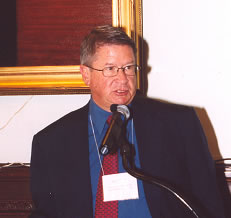 John Clark: I am John Clark, Chairman of
the Commission; Butch Childers is Chair of our effort in reaching out to
the law schools. I’m simply here to say how much we appreciate what the
New York State bar has done in this area to break the ice and get some discussion
going. I think that Butch Childers is absolutely right -- this is not a
sprint, it is a marathon. This is going to be a long-term effort. I do
want to add just a brief moment, a reflection as I sat in the meeting this
morning. I was asked by a federal judge in another state to come to her
state and participate in an intervention on her husband. He was a good friend
of mine; he was an endowed professor in the principal law school in his state. I
had known him for years and I knew about his problem. I went to that state
and I participated in that intervention. It began at 8:00 in the morning
when I rang the doorbell at the house. With me was the Chief Justice of
the Supreme Court of his state, the President of the Bar Association, the
Executive Director of the Bar Association, the Dean of his law school, his
favorite all time student in his years of teaching, and inside the house
was his wife and his daughter and we all joined together to talk to him about
his problem.
John Clark: I am John Clark, Chairman of
the Commission; Butch Childers is Chair of our effort in reaching out to
the law schools. I’m simply here to say how much we appreciate what the
New York State bar has done in this area to break the ice and get some discussion
going. I think that Butch Childers is absolutely right -- this is not a
sprint, it is a marathon. This is going to be a long-term effort. I do
want to add just a brief moment, a reflection as I sat in the meeting this
morning. I was asked by a federal judge in another state to come to her
state and participate in an intervention on her husband. He was a good friend
of mine; he was an endowed professor in the principal law school in his state. I
had known him for years and I knew about his problem. I went to that state
and I participated in that intervention. It began at 8:00 in the morning
when I rang the doorbell at the house. With me was the Chief Justice of
the Supreme Court of his state, the President of the Bar Association, the
Executive Director of the Bar Association, the Dean of his law school, his
favorite all time student in his years of teaching, and inside the house
was his wife and his daughter and we all joined together to talk to him about
his problem.
We were there for two and a half hours. He was told he would be removed from the House of Delegates of the ABA if he didn't get sober, he was told he was going to be retired from his professorship at the university if he didn't go to treatment, he was threatened with divorce if he didn't get treatment and his daughter said that she was never going to allow any of her friends to come over the house ever again if he didn't go to treatment. After two and a half hours he reluctantly agreed to go to treatment where he stayed 7 days and decided he needed to leave to come home to grade papers. He has now been retired from his law school, he has now been excluded from the House of Delegates of the American Bar Association and all the other things have come to pass. He's had several apparent strokes, I can't say that those are directly related to his alcoholism, but the poor guy is in really sad shape, and I wish I had been there earlier to say something to him. But I can't help but reflect upon that, and one other brief incident, I was asked to contact another university on behalf of a full professor, happened to be an undergraduate, Chairman of the department, he's a crack cocaine addict. I talked to the provost who I know, still has absolutely no policy and didn't know what to do, all he wanted to know was who the professor was. He met with all of his names, he would call me back, he was surprised to find that the Deans were willing to give the guy an immediate leave of absence if he wanted to go that day for treatment, because he wasn't prepared to do that. He said well, if it's a problem, he can wait until the end of the year and go during the summer. That professor, now it is the end of the summer and he's living in a halfway house, his wife has sued him for divorce and he, if he had one day of sobriety right now, I don't even think he's had that. It's around, it's around all of us, and I certainly appreciate the New York State Bar's interest in that subject. Thank you very much.
James Moore: Thank you John. John, the ABA COLAP is holding meetings in Canada in October, what are the dates on that?
John Clark: October 14th through the 17th and we certainly hope that the New York State Bar continues to show its interest in this area, because we will be discussing these issues at that meeting in Victoria and we hope you have a great presence at that meeting.
James Moore: It's now my great pleasure and privilege to introduce to you our next speaker, my friend and a respected colleague, Judge Joseph Bellacosa. Judge Bellacosa is currently serving as the Dean of his alma mater, the St. John's University School of Law. Prior to assuming that role, Judge Bellacosa had by what any measure would be a most distinguished and remarkable career in the law. The Judge was an undergraduate at St. John's, and he then graduated from his law school where he was an associate editor of his law review. Then became a confidential law clerk to one of the presiding justices of our Appellate Divisions, then became a faculty member at his alma mater and he became the Associate Dean. From that position he became the Chief Clerk of the New York Court of Appeals. Ultimately, he became New York's Chief Administrative Judge; then, by appointment from then governor Mario Cuomo, he became a member of the New York Court of Appeals where he served a full term. Along the way Judge Bellacosa has chaired groups, which have addressed issues as disparate as sentencing guidelines and law school accreditation. However, it was in 1999 that the Judge undertook what I think was the most important task which he undertook, other than serving as a member of the Court of Appeals. In that year he agreed to chair what came to be known as the Bellacosa Commission, which technically was entitled the Commission on Alcohol and Drug Abuse in the Legal Profession. That is the commission that Judge Kaye spoke to us earlier about today. That commission was peopled by some of the most knowledgeable students of this subject and issued its report about two and a half years ago. That report led to the creation of the New York State Lawyer Assistance Trust, which has added new strength to New York's many lawyer assistance programs. If you believe in numbers, you will be impressed by the fact that since the Bellacosa Commission issued its report, referrals to New York's two major lawyer assistance programs, the State Bar Association's program and the City Bar's program have more than doubled. Here to tell you more about work of the Bellacosa Commission and substance abuse as an issue in law schools is the Dean to all of us, the Judge, Joseph Bellacosa.
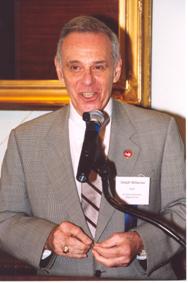 Joseph Bellacosa: From Jim's introduction, for
which I thank him, the word is getting out. I think the word is even getting
out to the Supreme Court of the United States, because had they ruled otherwise
in Grutter yesterday, a lot of people would
have been driven to drink, particularly in education, so we thank them for
their ruling in Grutter v. Bollinger.
Joseph Bellacosa: From Jim's introduction, for
which I thank him, the word is getting out. I think the word is even getting
out to the Supreme Court of the United States, because had they ruled otherwise
in Grutter yesterday, a lot of people would
have been driven to drink, particularly in education, so we thank them for
their ruling in Grutter v. Bollinger.
Titles. The “Judge” and “Dean” and many people asked me what they should call me, and I just say I am Joe from Brooklyn to most people, including in my family. But I must share with you that when I first went to my alma mater, the law school after leaving the New York State Court of Appeals and people would ask that question, I would kind of shrug and say I am the Dean, it's the Dean, it's not the judge title, which many retired judges hold on to, and then I found about a month or two into my tenure as Dean that people weren't asking the question anymore, and they were calling me a lot of other things; most of them under their voices.
I am also pleased and very, very proud to have been asked to be a participant in this program today. Needless to say, the keynote by my friend and colleague and our Chief Judge, Judith Kaye in identifying what she viewed as the initiative at the time was very, very encouraging to me, and I thought about Ray Lopez and David Pfalzgraf and I maybe 15 years ago we could have met in a telephone booth downstairs as we talked about these things, and look at what has come about in those years of effort and initiative and awareness, the broadening of our understanding of these things so very, very important.
I could echo, as well, sitting through this morning many of the primary themes that were hit by so many of the presenters. I could cherry-pick some of the wonderful comments, but I think that what I need to do is present to you my sense of being a proud parent, a proud parent of the Lawyers Assistance Trust. Parents don't operate alone, success has many parents, failure is an orphan. The number of people who participated in the work that brought about the building block, because there is still much more to be done as we know, the building block of the Lawyer Assistance Trust is something to be very proud of, but it also is very humbling as we listen to so many of the remarks today.
And it's very important to keep that in mind in connection with where do we go from here. I can remember in our deliberations over those many months of meetings and even the hearings, that the consensus that was formed was not always there. There were very, very sharp differences among our group, although we all had our eye on the destination point, something that would be progress, progress in the sense of moving from indifference to being enablers or facilitators to being active participants in a very, very important work, because that was the charge from the Chief Judge. As you could tell, and those of you who watch what she does, this was not to be a report, this was to be an Action Plan. She gave me that phrase the very, very first time.
I think of that in connection with and putting it in perspective 40 some odd years ago there was a Surgeon General's report, a lot of activity, and here we are still fighting that battle day in day out, with all of the awareness that we have throughout this country and the world. Well, it was only 10 years ago and I see my colleague and friend also Bob Stein with the AALS report and in the commission that was referred to and I cringe in humility by this title, the Bellacosa Commission, because it just was something that was a collegial process of so many. But that's only a couple of years old, it's in its adolescence, it's in its infancy and yet look at this program today.
Think of what you heard about how it has reached out to do what? To provide the educational sweep that is now taking hold, to provide the direct assistance and intervention that is so necessary in this area. I hesitate to use the word problem, because as one of the speakers indicated, it's an issue, it's a concern, it's something that we have to deal with. We thought that the Lawyer Assistance Trust was a very important step, an institutional awareness and a visibility that would add to the Lawyer Assistance Committees that were. And lo behold it came to pass and we got our Chief Judge behind it and all of you who are working so hard in it.
At our school, one of the things that we have done in looking at again from the legal education standpoint, we try to use every method possible. We have got the direct orientation piece. We have got the professional responsibility piece where the team comes in and talks to all the students, and I must share with you somewhat uneasily one of the experiences that I am sure we all experience from time to time, you try to move along and there are some setbacks. This past year when the committee came in it was a very, very good program but on the boards, because there was a spring fling that day, on the board while they were presenting this important issue for hundreds of law students, was free beer. All you can drink. And I thought to myself, oh, the incongruence of this, the inconsistency of this.
How do we ever bring this down in terms of the facilitation in the law schools for all the different programs that we have talked about? And yes, this is, as has been said, a marathon --a long, long trip around the course.
It's not for the faint hearted, as some have said, and I was reminded in that connection of a different image. When I first went to Albany in 75 at the request of then Chief Judge Charles Breitel, an extraordinary figure in our judiciary and in this Bar Association and in this city, one of the things he said to me about court reform, another issue of importance was that it was not for the short-winded. He said, Joe, it's for the long-winded, and I don't mean by way of speeches. So I guess I am remembering the lesson of my former Chief Judge and mentor as well. One of the things I think we have to be content with as we go about this work together, those who lead from the judiciary and from the Bench and the Bar and also from the Lawyers Assistance Programs and the Lawyers Assistance Trust, is to be content to some extent with the modesty of our approach. That may sound strange, because we want to be aggressive and get on it there and change the world, and we want to get everybody. We are not going to. So we have to be realists about that as we go about strongly pursuing this work and this goal, but we should be content to this extent; the more we can keep moving on a path that enlarges the educational awareness and gets more people involved in assisting and understanding how serious and deep and pervasive a problem this is, the more we will accomplish and be satisfied that this is a task, a noble task worth engaging in. We see it in the Lawyers Fund for Client Protection reports; we see it in the wonderful brochure that landed on my desk only yesterday from the Lawyer Assistance Trust. We see it in so many of the other manifestations of empirical studies that have been done and that will be reissued, but we see it one on one with some of the individuals, whether it's students or professors or others who come to our mind in the profession.
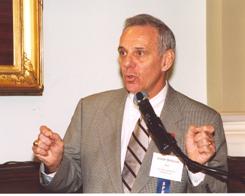 But we look at this now from a legal education standpoint
today. One of the things that I want to emphasize that I didn't hear enough
of in this morning's piece as we focused on legal education, is the effect
on the public confidence. On the public. Ultimate victims of so many of
this, we know who the direct victims are, but we sometimes lose sight of
that larger universe that we need to be concerned about and what that does
to them, our profession and the trust that is given to our profession in
the fiduciary responsibilities that we have.
But we look at this now from a legal education standpoint
today. One of the things that I want to emphasize that I didn't hear enough
of in this morning's piece as we focused on legal education, is the effect
on the public confidence. On the public. Ultimate victims of so many of
this, we know who the direct victims are, but we sometimes lose sight of
that larger universe that we need to be concerned about and what that does
to them, our profession and the trust that is given to our profession in
the fiduciary responsibilities that we have.
My role for years with some of the people that I have been fortunate enough to be associated with, even with a leadership responsibility that was given to me by the Chief Judge and even now with the responsibility, a word that is in your theme for today's program, my sense about that is to be a witness to the depth and sweep of this problem of this issue. To be a part of the solution. There is no total solution, as I have indicated, in terms of some temperance movement or total abstinence, although for some we know through AA and otherwise, there must be total abstinence. But in terms of reaching as many as we can, being satisfied that one on one, or as the phrase so familiar to so many in this room, “one day at a time,” something has been accomplished, one individual has been saved from him or herself and that individual in turn will not inflict some major damage and injury on so many others, because the potential there is the infliction on so many by just one.
So saving the one is so important in that public, public good that comes from this work. So being a witness, being someone who is there to stand by in kind of a validation of how important this issue, like so many other issues, the appeal to any of us in the Bench and Bar for other issues of court reform and of interest that are very important; it's tremendous. The array and the litany could go and on and on and on and we must pick and choose and we must prioritize, and this is one we have seen over the years, so many of you far more poignantly than I, has been a blot on the profession.
We are not alone; we know that; other provisions and individuals throughout. But because of the fiduciary relationship and trust that we have endured and been, by the way, the beneficiaries of, we have a greater responsibility, it seems to me, to be participants and witnesses and assistants to the improvement in this area. Humility goes a long way in terms of what the expectations of the commission were. When we did our work, we did not know that we could accomplish very much, we thought perhaps it would just be another report. But there were many people on that commission who said no, we are going to fulfill the mission and the charge that has been given to us, because we have lived this and we need to make it something more.
The fact that the Lawyers Assistance Trust came about as an institutional reminder to all of the others working in the field, providing the kind of resources that it provides and the kind of continuity, institutional continuity and permanence with respect to this issue, makes everyone who is involved know this is not going away and needs to be addressed, and there are ways and people and institutions who will assist us in dealing with it. That's what I think is one of the major accomplishments, even as I think about the future, and where does the Lawyers Assistance Trust take itself to the next level of awareness? Because like the Surgeon General's report of 40 years ago, the Stein report and the commission for the New York State I will call it the Chief Judge's initiative out of the sense of true modesty, that needs to be propelled onto the billboards and into the internet and into the awareness and the consciousness of all of our students, so much more so that so many of them cannot only help themselves, but that they can help their brothers and sisters who sit besides them in the classes and that they can become part of, they can be part of this solution that so many of you have committed yourself to. Those of you who work in the field and those of you, to come back to the word and theme of today about legal education, those of us who have responsibility to our students and to those whom our students will serve.
It seems to me that is such a noble calling, that the corollary of lighting a candle so that there may be more light, the educational part and then adding to give someone a candle to pass along to someone else, is worth our effort, worth our while. So many of you have talked about how that has given you fulfillment in the way that you have gone about your professional lives. As an adjunct to whatever you do as lawyers or judges or individuals involved in this work in the social sciences, there cannot be any more fulfilling or satisfying reward. You have saved a life. You have saved other lives and you have added to the dignity of the profession that we love and that we are part of.
For that, I suppose, the sweetest words I could hear when the conference for decision days is “I concur,” I remember how sweet it was in my ears when you were a judge, “I concur,” so I could concur that it's the last bastion, but I am not so sure that the law schools aren't in some senses the first bastion into the awareness and the wider understanding and sensitivity for some. It's their first opportunity after they come out of those college years when a maturity of purpose and responsibility in one's life is taking hold. I read in Time Magazine about a month ago when they had an essay about drinking and beginning drinking. A particular criminal justice student indicated that his class schedule was set up only for classes in the afternoon because it would otherwise interfere with his drinking at night and he couldn't really deal with it in the morning because it was too difficult to get up. How many of you from the stories you have heard can resonate and worry about that? That if that's what was referred to as the culture, and that is the culture of those coming in to a professional school that is there to educate them to serve people in ethical and moral and legal ways that are of the highest excellence, then we have to worry that it may be the first opportunity in the professional universe of dimension to address this question.
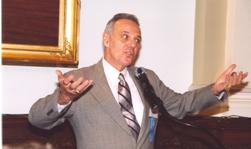 I think that this program today absolutely, and I said
this to some of my colleagues who were on the commission with me, absolutely
exhilarating and thrilled me. The fact that so many people could come together
and devote an entire day to this issue and this cause, knowing that from
here it can only grow, I am certain the next time you have one you may have
to rent Madison Square Garden or the Javitz Convention Center, after the
Bar, since we have by the way with 15 law schools in New York we are going
to have almost 10,000 taking the Bar in July. So maybe we ought to slip
a little card into them, too, it will take their minds off what they are
facing with the exam itself.
I think that this program today absolutely, and I said
this to some of my colleagues who were on the commission with me, absolutely
exhilarating and thrilled me. The fact that so many people could come together
and devote an entire day to this issue and this cause, knowing that from
here it can only grow, I am certain the next time you have one you may have
to rent Madison Square Garden or the Javitz Convention Center, after the
Bar, since we have by the way with 15 law schools in New York we are going
to have almost 10,000 taking the Bar in July. So maybe we ought to slip
a little card into them, too, it will take their minds off what they are
facing with the exam itself.
Seriously; to close, I want to say that may your work, our work multiply in this noble effort to improve the understanding and the direct assistance to those who have a need for our help, because you will do something tremendous for yourself, for some other people and for the legal profession. So thank you very much for having me as your luncheon speaker.
James Moore: I am sure that every one of you is feeling like I do right now. There is such passion and exuberance at what Judge Bellacosa has to say that you want to just stand up and walk out of the room and do something. Thank you, Judge. Perhaps some of you have a question or two you would like to ask the judge, either about the work of the commission or their recommendations or anything?
Joseph Bellacosa: If not, I will tell one story, this is lunch and I was saying to Jim, we were talking about this, you want some light hearted fare? He said no, no, this is a serious day, so for the most part I think I did the serious thing. The one light hearted thing that comes to mind is I am glad that we didn't have a cocktail reception beforehand for lots of reasons that we could all agree on, one of the other reasons is that in the past one time after a cocktail reception I got up to do a speech as a judge and in the back there was a heckler, I pulled out a sheaf of paper, said “no speech, no speech”. So being adaptive to the heckler I took the remarks and tossed them away, it was on the rule against perpetuity or something, I tossed it away and I did about a three minute reprise of what I had planned, and decided to be cute myself, which one shouldn't be, and I said well, that wasn't too bad, was it? And the heckler responded, “it wasn't good as no speech”. So with that --
James Moore: Questions, comments, observations?
Audience Member: I am Nadine Walt from Louisville, and I want to do a follow-up on “all the beer you can drink.” One of the things that we haven't touched too much on, although Laurie talked a little bit about it this morning raising the issue, is how do you change the social culture at our law schools? We have talked a lot about connecting people who have identified problems and need help, but we haven't talked at all about changing the culture and maybe we can do a little, what was your response when you realized the free beer was on the blackboard?
Joseph Bellacosa: I come back to the modesty sense, you know you are not going to change the culture entirely, because that's too big a call, and we want to address and do what we can. But one of the things that we have done other than orientation, professional responsibility is work with the students at the student Bar Associations and the student organizations to let them know about the responsibility they have when they are sponsoring different kinds of functions and what the drinking rules ought to be. Some of the things that were recommended by the Stein commission report, there you start slowly and how do you do it? Preaching won't do it. Getting up and lecturing as a former judge, especially not as a Dean, maybe as a professor, won't do it, but by example. Making sure that when students are around you say I will have a tonic and lime instead of give me a double Jack Daniels when you are having some kind of a program. Trying to have some function, which not only have alternatives to alcohol, but have no alcohol and encouraging that. Doing it by example as well as by the kinds of programs you run is the most you can do at this point to make a dent in the culture. I would think changing it would be too large an order.
Biographical Information
Joseph W. Bellacosa
Dean, St. John’s University School of Law
B.A., St. John's College; LL.B. (J.D.), St. John’s School of Law
Dean and Professor of Law Joseph W. Bellacosa returned to his Alma Mater in August 2000 to assume the Deanship of the School of Law after having completed a 14-year term as Associate Judge of the New York State Court of Appeals, the State's highest court. As a law student, Bellacosa served as Associate Editor of the St. John's Law Review.
Dean Bellacosa served as Chief Administrative Judge of the State's Unified Court System (1985-87). He has been a member of numerous committees and associations including the ABA Accreditation Committee for American Law Schools (1987-1993), the American Law Institute, the Association of the Bar of the City of New York, and the New York State Bar Association. Additionally, he served as Chairman of the New York State Sentencing Guidelines Commission (1983-85) and was active as an Officer and Chairperson (1995) of the ABA Section on Legal Education and Admission to the Bar (1992-96). He recently served as Chairman of the New York State Chief Judge's Commission on Alcohol and Drug Dependency in the Legal Profession. A member of the St. John's University Board of Trustees from 1995-2000, Dean Bellacosa is also a recipient of numerous awards and professional recognitions including an Honorary Degree (1987) and Medal of Honor (1998) from St. John's University, the New York State Bar Association's Gold Medal for Distinguished Service (2001) and the Chief Judge Stanley H. Fuld Award of the Commercial and Federal Litigation Section of the New York State Bar Association (2002).
Dean Bellacosa previously served as law secretary to the Hon. Marcus G. Christ, Presiding Justice of the New York State Appellate Division, Second Judicial Department (1963-1970); as a faculty member and Assistant Dean (1970-75) at St. John’s Law School; and as Chief Clerk of the Court and Counsel at the New York State Court of Appeals (1975-1983). The author of Practice Commentaries to McKinney's eight-volume Criminal Procedure Law of the State of New York (1974-1985) and of numerous published articles and works, he is also a frequent lecturer on a range of legal subjects.